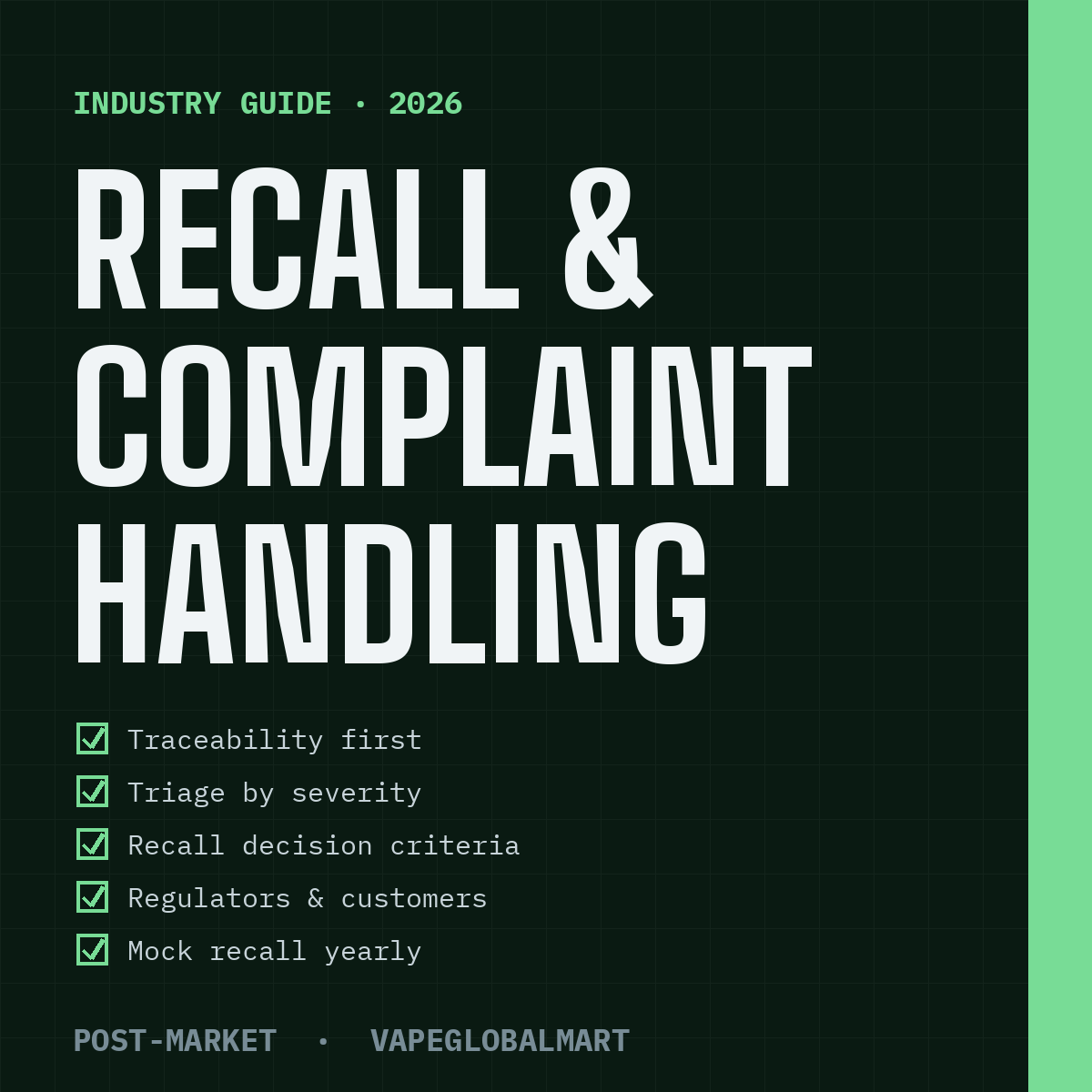
Vape Recall, Complaint Handling & Traceability 2026: Building a Post-Market Process
Published · 8 min read
Key takeaways
- A recall is a process you design before you need it: traceability, complaint intake, triage, decision rights, regulator contact and customer communication.
- Traceability is the foundation. If a batch code cannot be mapped to production records, components and shipments, you cannot scope a problem or prove you acted quickly.
- Complaints are data. Classify them by severity, count them by batch and look for patterns weekly; most recalls start as a cluster of small complaints.
- Battery incidents, leaking liquid and child-safety failures are the categories most likely to trigger regulator interest, and should have the fastest escalation path.
No vape manufacturer plans to recall a product. But a product with a lithium battery, a heating element and a liquid containing nicotine will, sooner or later, generate a complaint serious enough to test the company's process. The brands that handle it well are rarely the ones with the best luck; they are the ones that decided, in advance, who does what.
This guide explains how to build a post-market process: traceability, complaint handling, escalation, recall decisions, regulator contact and customer communication. It supports our guides to supplier due diligence, test reports and counterfeits.
Scope note. This is a general business guide, not legal advice. Duties to report incidents, recall products and keep records differ by country and product category. Confirm obligations with the regulator or a local adviser for every market you sell into.
1. What can go wrong
Post-market problems in vaping fall into a small number of families:
| Family | Examples | Why it escalates |
|---|---|---|
| Battery and electrical | Overheating, swelling, fire, charging faults | Physical injury and property damage; strong regulator interest |
| Leakage and contamination | Leaking pods, liquid on skin or in mouth, foreign matter | Safety and consumer-protection issues; often batch-related |
| Child safety | Packaging that children can open, accidental ingestion of liquid | High severity, high public sensitivity |
| Labelling and compliance | Wrong warning, missing ingredient, mismatched strength | Regulatory breach even if the product is safe |
| Performance and quality | Dead on arrival, burnt taste, inconsistent puffs | Mostly commercial, but clusters can reveal deeper defects |
| Counterfeit or tampered goods | Fake or refilled product reaching users | Brand and safety exposure; see our counterfeit guide |
2. Traceability: the foundation
Everything else depends on being able to answer: which units are affected, where did they go and what went into them?
A workable traceability scheme links:
- Batch or lot code printed on each unit and carton.
- Production record: date, line, shift, operator, inspection results.
- Component lots: battery cell, coil, PCB, pod material, liquid and nicotine lots.
- Test records: reports tied to the batch or revision; see our test-report guide.
- Shipment record: customers, destinations, quantities and dates.
- Artwork version: so labelling errors can be scoped; see packaging and labelling.
Test the scheme by picking a random unit and tracing it end to end in under an hour. If you cannot, the scheme is not yet working. Ask your factory and your distributors for the same records; in an OEM or ODM relationship, the contract should require them.
3. Complaint intake
Make it easy to complain and impossible to lose a complaint.
- One intake path (email address, form or hotline) published on the website, packaging or leaflet, and given to distributors.
- A log with date, channel, product, batch code, where it was bought, description, severity, photos and actions taken.
- Acknowledgement within a defined time, with a reference number.
- A request for the unit, packaging and proof of purchase so the product can be examined.
- Records kept for a period set by your obligations and by good practice.
Distributors and retailers should forward complaints to you within a fixed time; write that into their contract.
4. Triage: classify by severity
Use a simple three-level scale that everyone in the company understands.
| Level | Definition | Response target |
|---|---|---|
| Critical | Injury, fire, ingestion, suspected child-safety failure, any report involving hospital or emergency services | Same-day escalation to a named decision-maker; stop-ship considered immediately |
| Major | Leakage with skin contact, repeated overheating, labelling error that may breach regulation, suspected counterfeit | Escalate within one working day; investigate by batch |
| Minor | Performance, taste, cosmetic defects | Standard handling; counted for trend analysis |
Do not ask staff to judge whether a complaint is "really" a safety issue. Define triggers (keywords, symptoms, photos of damage) that automatically raise the level.
5. Investigation
For major and critical cases:
- Secure the evidence: unit, packaging, charger, receipts; photograph before touching. Handle damaged batteries as a hazard, not as a sample to open casually.
- Trace the batch and see how many units shipped, to whom and where.
- Check production and inspection records for that batch and any component lot changes.
- Check for similar complaints in other batches and markets.
- Examine and test the returned unit and retained samples, using a qualified laboratory where needed.
- Determine root cause: design, component, process, storage, transport, misuse, or counterfeit.
- Document the conclusion and the evidence behind it.
Retained samples from each batch, kept sealed, make this much faster and more credible.
6. The recall decision
A recall, withdrawal or stop-sale decision should not be improvised.
Define the decision-makers in advance: usually a senior manager, quality lead and legal adviser, with authority to stop shipments immediately.
Use clear criteria. Questions to ask:
- Could the defect cause injury or serious harm?
- Is it confined to a batch, or does it affect a design or component across batches?
- Are units already with consumers, or still in the supply chain?
- Does any regulator require notification or recall in the markets affected?
- Can the risk be removed by a warning or instruction, or only by returning the product?
Choose the action proportionately:
| Action | When it fits |
|---|---|
| Stop-ship | Suspected defect in stock and in transit; investigation under way |
| Withdrawal from distributors and retailers | Defect confined to stock still in the trade |
| Consumer recall or safety notice | Units with consumers and a credible risk of harm |
| Corrective notice | Labelling or information error without physical risk |
When in doubt about safety, act first and investigate in parallel. Waiting for certainty is usually more expensive than acting early.
7. Dealing with regulators
- Know the rules per market before an incident: who must be told, how fast and in what form. Regimes differ for consumer-product safety, tobacco and vaping and dangerous goods.
- Name a regulatory contact within the company and make sure distributors know who it is.
- Be factual and prompt. Share what is known, what is not yet known and what you are doing about it.
- Keep a record of every communication and deadline.
- Take legal advice for critical cases, especially where injury is involved or where your responsible entity in a market is a third party.
If you rely on an importer or distributor as the responsible entity, agree in writing how they will receive, escalate and report incidents.
8. Communicating with customers and the trade
- Say what happened, what to do and how to reach you. Lead with the action customers need to take.
- Use plain language in every market language, and use the same facts across channels.
- Provide a remedy: replacement, refund or collection, as appropriate.
- Avoid blame and speculation in public statements.
- Inform distributors first where the product is still in the trade, so they can quarantine stock.
- Track the response: how many units returned, how many accounted for, and when the recall can be closed.
9. Learning loop and metrics
Review the log monthly and track a few numbers:
- complaints per thousand units sold, by product and batch;
- share of complaints by severity and by family;
- time from complaint to acknowledgement and to investigation;
- time from critical report to decision;
- repeat causes by supplier or component lot.
Feed findings back into supplier controls, specifications and due diligence. Run a mock recall once a year: pick a batch, trace it and test how quickly you could notify every customer.
10. Checklist
- Batch code on every unit and carton, mapped to production, component and shipment records
- Mock trace completed in under an hour
- Single complaint intake path, published and shared with distributors
- Complaint log with severity classification and defined triggers
- Named decision-makers with authority to stop shipments
- Retained sealed samples from each batch
- Recall and notice templates prepared in each market language
- Regulator obligations summarised for each market, with named contact
- Contract terms requiring suppliers and distributors to share records and forward complaints
- Monthly complaint review and annual mock recall
Frequently asked questions
What is the difference between a recall and a stop-ship? A stop-ship halts further shipments from your own stock while you investigate. A recall or withdrawal also deals with units already in the trade or with consumers.
Do I need a recall plan if I only sell through distributors? Yes. Regulators and consumers will still look to the brand or responsible entity. Make sure contracts require distributors to hold records, forward complaints and cooperate in a recall.
How long should I keep complaint records? Keep them for the period required in your markets and at least as long as the product's shelf life and typical service life. Check local rules.
What if I think the problem is a counterfeit? Treat safety first, preserve evidence, and follow our counterfeit response steps. A counterfeit can still require customer communication.
Bottom line
A good post-market process is quiet insurance: traceability that works, complaints that are logged and classified, decision-makers with authority and a plan for regulators and customers. Build it while nothing is wrong. For the wider compliance picture, pair it with the market-entry checklist and the customs seizure playbook.
Related reading
We work with the same brands featured in our knowledge base. Tell us your target market and volume, and we'll route you to compliant, in-stock inventory.
Start a wholesale inquiry