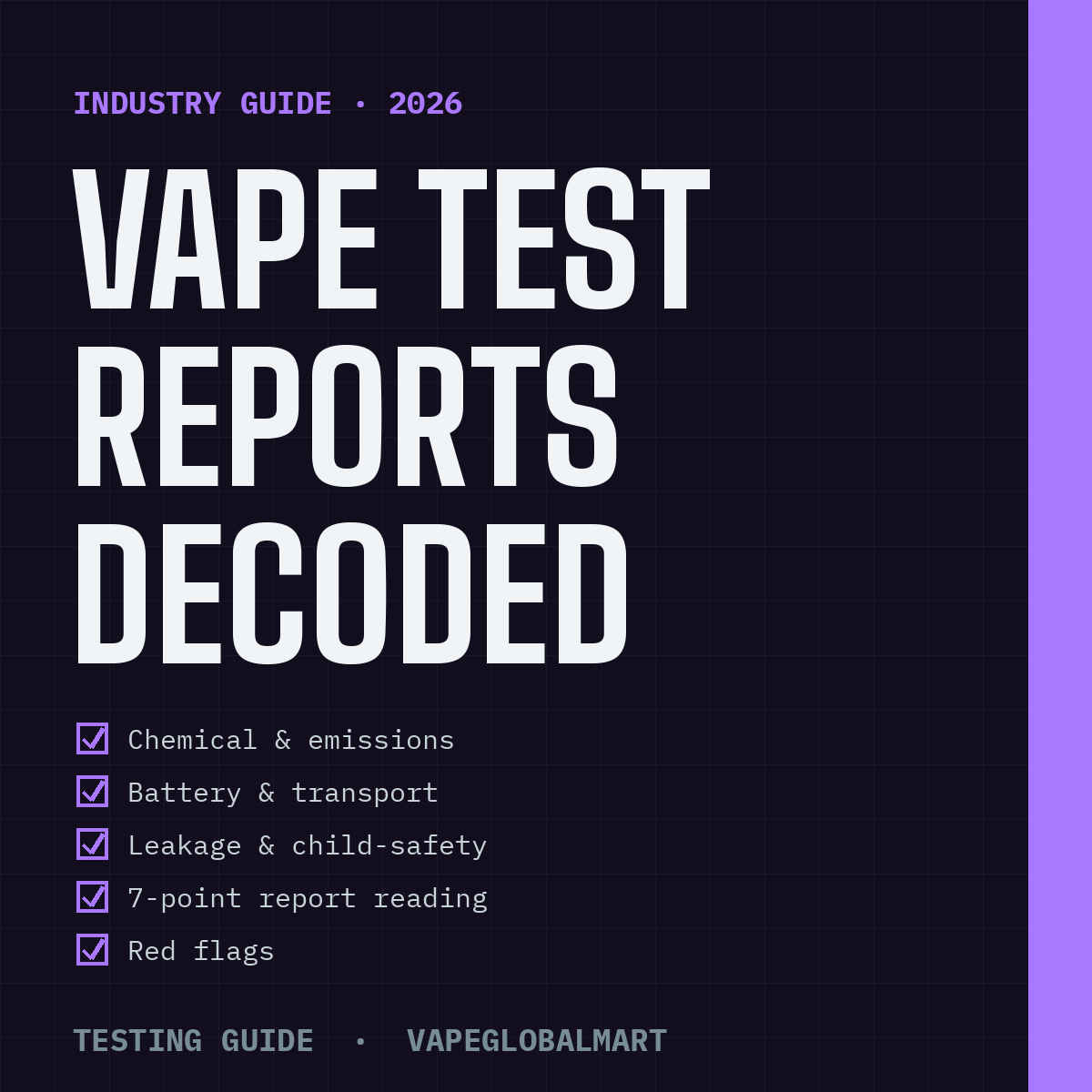
Vape Test Reports Explained 2026: Chemical, Emissions, Battery and Leakage Testing
Published · 8 min read
In the vape trade, a test report is both a sales document and a legal document. Buyers ask for it before ordering, regulators ask for it when a product is notified, customs and carriers ask for battery paperwork before accepting a shipment, and retailers ask for it when onboarding a brand. Yet most buyers cannot tell a meaningful report from a decorative one — and many suppliers know it.
This guide explains which tests matter for a vape, what each report should actually show, how to read one critically, which red flags to watch for, and how to build a test plan that survives scrutiny in more than one market. It supports our supplier due-diligence checklist and our market guides for the EU, UK, US and New Zealand.
Scope note. This is an informational guide for B2B readers, not legal or laboratory advice. Which tests are required depends on the destination market and changes over time. Use this article to ask better questions, then confirm requirements with the regulator, an accredited laboratory or a local adviser.
1. Four families of tests
Vape testing falls into four families. A complete product file normally touches all four, but each market weights them differently.
| Family | What it answers | Typical evidence |
|---|---|---|
| Chemical (liquid) | What is in the liquid, at what concentration, and is it within limits? | Ingredient analysis, nicotine content and uniformity, contaminant screening |
| Emissions (aerosol) | What does the user inhale when the device is used? | Emission analysis under a defined puffing regime, heavy metals, carbonyls |
| Electrical and battery | Is the device safe to charge, carry and ship? | Cell safety, transport testing, charging and short-circuit protection |
| Physical and packaging | Does the product behave as designed and protect users? | Leakage, child-resistance, tamper evidence, durability |
A report from one family says nothing about the others. A supplier who offers only a one-page liquid analysis has not demonstrated that the device is safe to ship.
2. Chemical testing of the liquid
What a credible liquid report should show:
- Nicotine content per flavour and strength, compared with the labelled value, with a stated tolerance. A label that says 20 mg/ml and a result that says 26 mg/ml is not a rounding error — in several markets it is a legal breach. See our guide to nicotine strength and formulation.
- Ingredient identification for each flavour, not a single report for the whole range. Flavour systems are the most variable part of a liquid.
- Contaminant screening, such as heavy metals and residual solvents, where the market asks for it.
- Batch information: sample description, batch number and date, so the result can be tied to a production run.
Common weaknesses: a report covering one "master" flavour presented as proof for ten; results with no tolerance statement; and nicotine reports where the sample ID cannot be traced to a batch.
3. Emissions testing of the aerosol
Emission tests measure what is produced when the device is activated. Two points matter more than any individual number:
- The test conditions. Puff volume, duration, interval and power setting determine the result. A report that states no regime cannot be compared with another.
- The device-liquid pairing. Emissions depend on both coil and liquid. A report on the device with a different liquid, or an older coil, does not describe the product you are buying.
Typical analytes include heavy metals leaching from the heating element and metallic components, and carbonyl compounds produced by thermal breakdown. Regulators that require emissions data usually want it per product configuration, so every change in coil resistance, wick or power setting can mean a new report.
4. Electrical and battery testing
This is the family most often skipped by small suppliers and the one most likely to stop a shipment.
- Cell safety. Look for evidence about the cell itself: its manufacturer, model and the safety standard it was tested to. A supplier who cannot name the cell manufacturer cannot prove cell safety.
- Transport testing. Lithium cells and batteries must meet the UN transport test requirements before air, sea or road carriage, with a summary available to carriers and forwarders on request. Without it, a forwarder may refuse the cargo or treat it as non-compliant dangerous goods.
- Device-level protection. Overcharge, over-discharge, short-circuit and thermal protection, and the charging port and cable.
- Electromagnetic and restricted-substance compliance. Electrical products sold in many markets must meet electromagnetic-compatibility and restricted-substance rules in addition to vape-specific rules.
- Battery and waste law. In the EU, new battery rules add removability, labelling and due-diligence duties that affect device design; see our battery compliance guide.
A battery that passes in one revision may not pass after a cell change. Treat cell supplier as a controlled variable.
5. Physical, leakage and child-safety testing
- Leakage. A leaking pod is a user-safety issue, a customer-complaint driver and, in shipping, a contamination risk. Ask for leakage tests under temperature and pressure variation relevant to air freight.
- Child-resistance and tamper evidence. Where required — typically for refill containers and some devices — the claim should rest on a test, not on a design statement.
- Durability and function. Draw resistance, coil life, button and charging cycle tests support quality claims and reduce returns.
6. How to read a test report critically
Use this seven-point reading routine on any report you receive:
- Laboratory identity. Who issued it? Is the laboratory named and contactable, and does it hold relevant accreditation?
- Sample description. Does it name the exact product, flavour, strength and hardware revision?
- Dates. Is the test date plausible relative to the production date and any later design change?
- Method. Which standard or method was used, and does the report give the limit and the measured result, not just "pass"?
- Scope. What was not tested? A report that covers one parameter is not a complete certification.
- Consistency. Do the numbers agree with the label, the specification and other reports in the file?
- Authenticity. Can the laboratory confirm the report number? A short email to the lab resolves most doubts.
7. Red flags
- A one-page certificate with a stamp and no data.
- A report from a laboratory that cannot be found, or whose address and registration do not match.
- Report numbers or formatting inconsistent with the laboratory's other documents.
- Sample descriptions that name a different model, flavour or revision.
- Dates that precede the product's design finalisation.
- Identical results across different flavours or strengths.
- Willingness to supply a report "after you order".
- A supplier who treats a request to verify with the laboratory as an insult.
8. Building a test plan that works across markets
- Identify target markets first and list the tests each requires; see the global regulation map.
- Define the product configuration freeze: hardware revision, coil, cell, liquid formulation. Anything outside the freeze triggers a re-test assessment.
- Test the worst case. For a range with several strengths, test the highest; for several coils, test the most demanding.
- Choose an accredited laboratory with experience in your target market's requirements, and ask for English reports with clear scope statements.
- Retain samples and raw data by batch.
- Plan retesting into the product lifecycle, particularly after component changes or when regulations change.
- Align reports with packaging and notification files, so the product name, revision and strength match everywhere; see our packaging and labelling guide.
9. Who pays and who owns the report
In OEM and ODM relationships the factory often commissions tests on its platform and owns the results. As a brand owner you need to know, in writing, whether you can use those reports in your own name, whether they cover your flavours, and who pays when a change forces a re-test. Our OEM/ODM guide covers this in the contract section. Test costs are also part of landed cost; see how to model total cost.
10. Test-report checklist
- Laboratory named, contactable and appropriately accredited
- Report matches exact SKU, flavour, strength and revision
- Test date consistent with product timeline
- Method, limits and measured values shown
- Nicotine result within the stated tolerance of the label
- Emissions regime stated, device and liquid paired correctly
- Cell manufacturer and model identified, transport test evidence available
- Leakage and, where required, child-resistance evidence available
- Report numbers verified with the laboratory
- Reports stored with batch records and artwork version
11. Bottom line
A test report is only as good as its match to the product in the box. Insist on the exact SKU, a named laboratory, visible methods and results, and independent confirmation of at least one report per supplier. Do that consistently, and you will filter out most of the weak suppliers before they cost you money. For the market-side view of the same discipline, pair this with the market-entry checklist and the export, Incoterms and payment guide.
Related reading
We work with the same brands featured in our knowledge base. Tell us your target market and volume, and we'll route you to compliant, in-stock inventory.
Start a wholesale inquiry